
The 6 Best Agent Experience Optimization (AXO) Tools in 2026
The tech stack that will help you improve your site for AI Agents
The tech stack that will help improve your site for AI Agents
As AI agents become capable of browsing websites, completing forms, making purchases and carrying out tasks on behalf of users, businesses face a new challenge:
Can AI agents successfully use your website?
For the last decade, the work of digital teams has been to optimize experiences for humans. They measured conversion rates, analyzed user journeys and reduced friction using tools like analytics, session replay and A/B testing. Now a new type of visitor is emerging and that’s changing the game..
AI agents such as ChatGPT Operator, Claude Computer Use and OpenAI-powered assistants are beginning to navigate websites on behalf of users. These agents don't interact with websites exactly like humans do. They can struggle with complex forms, confusing navigation, authentication flows and poorly structured interfaces.
This has given rise to the new discipline of Agent Experience Optimization (AXO). AXO is the practice of ensuring AI agents can understand your website, navigate your pages, complete your forms and authenticate everything successfully. Think of it as CRO for AI-powered users.
AXO is a new frontier so the software that helps improve agent experiences is very new and developing fast. That means it’s hard to get a handle on which tools to use once you’ve made a decision to optimize your site for agents. In this guide, we'll look at the best tools for helping AI agents successfully interact with your digital experiences.
1. Zuko Agent Score
Best for: Agent form and checkout optimization
Zuko Agent Score is one of the first tools built specifically for Agent Experience Optimization.
Built by Zuko Analytics, who have been using data to optimize forms and checkouts for humans for over a decade, the tool inevitably focuses on the sharp end of the funnel: forms.
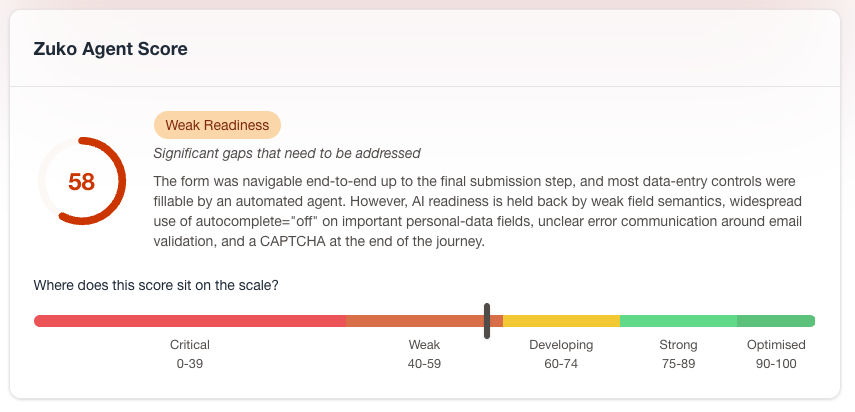
The platform tests forms and checkout flows using AI agents and identifies where they struggle, fail or abandon tasks. Rather than focusing on traffic or visibility, it focuses on the part of the journey that matters most: successful task completion.
Key features:
- Agent-based form testing including session recordings
- Checkout flow analysis
- AI failure detection
- Prioritized recommendations
- Agent completion scoring
Poorly built forms and checkouts are a big cause of agent failure - they get caught in a doom loop going back and forth between fields. Zuko Agent Score helps businesses identify and fix those issues before they impact conversions.
Used by: Ecommerce teams, CRO specialists, UX teams and digital analytics professionals.
2. Snowplow
Best for: Agent traffic analytics and event-level tracking
As AI agents begin interacting with websites, organizations need a way to distinguish agent traffic from human traffic and understand exactly how those agents behave.
Snowplow provides the event-level data foundation for analyzing these interactions in detail. Much of this traffic comes from agents and bots that don't run JavaScript, so Snowplow can also track requests at the CDN level, capturing visits that client-side analytics miss entirely. Unlike platforms that only return aggregated reports, Snowplow collects granular behavioral data that lands in your own data warehouse or lake, where you can model and query it however you need.
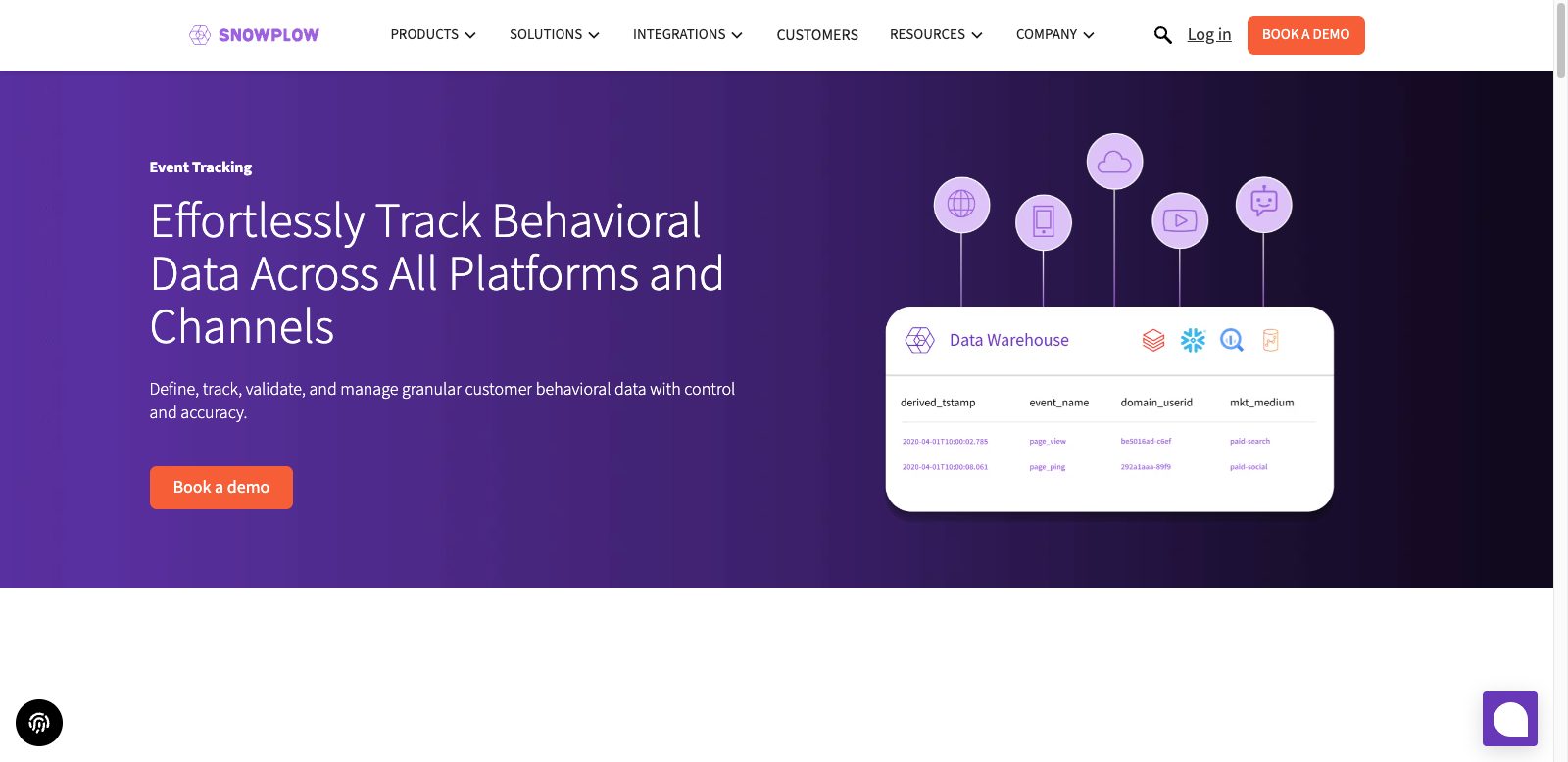
For teams investing in Agent Experience Optimization, owning that raw data matters. You can see how agents move through a site, where they hit friction, how their behavior differs from human visitors, and whether your AXO changes are having an effect over time.
Because the data is yours and structured at the event level, you can build your own agent analytics models and dashboards instead of waiting for a vendor to define them for you.
Key features:
- Event-level behavioral tracking across web, mobile, and server-side
- CDN-level tracking that captures agent and bot requests client-side tools miss
- Full ownership of raw event data in your warehouse or lake
- Bot and agent detection via user-agent and IAB enrichments
- Custom event and entity modeling for agent-versus-human analysis
While tools like Zuko Agent Score help identify where AI agents struggle on a specific journey, Snowplow gives organizations the underlying behavioral data to understand agent activity wherever it happens on their site.
Used by: Data and analytics teams, plus product and AI engineers building longer-term agent analytics capabilities.
3. Skyvern
Best for: AI agent workflow automation and real-world task execution
While some Agent Experience Optimization tools focus on measuring or testing agent interactions, Skyvern focuses on something equally important: enabling agents to successfully perform tasks on websites.
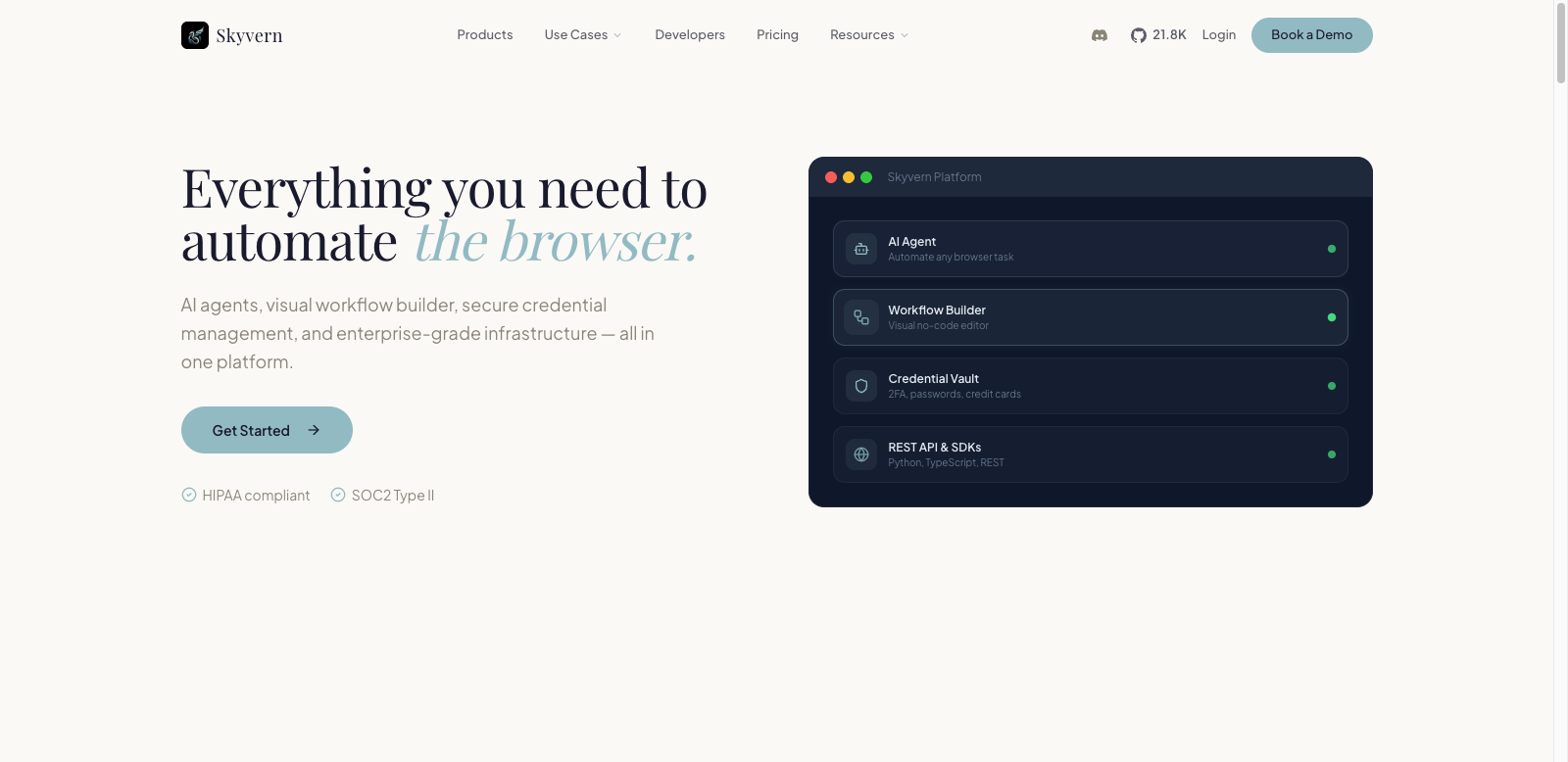
Skyvern is an AI-powered browser automation platform that allows agents to navigate websites, fill forms, click buttons and complete multi-step workflows using visual understanding. In simple terms, you give their agent a goal and you can then watch whether it can complete it successfully.
For AXO teams, Skyvern provides a practical way to understand how agents interact with their real-world interfaces. Businesses can use it to test critical workflows, identify obstacles that prevent successful task completion, and evaluate whether their digital experiences are truly agent-friendly. We particularly like that it provides logs that show you how the agent works its way through the site and where it encounters friction.
Key features:
- AI-powered browser automation
- Visual website understanding
- Multi-step workflow execution
- Form and checkout automation
- Agent task completion testing
Skyvern occupies a unique position within the AXO stack allowing teams to simulate and automate real agent journeys to better understand how those failures occur.
Used by: Product teams, AI startups, operations teams, and organizations experimenting with autonomous web agents.
4. Playwright
Best for: Testing complete agent and user journeys
Playwright is an automation framework that allows teams to simulate how users interact with a website.
In simple terms, it can act like a visitor using your site. It can open pages, click buttons, fill in forms, navigate menus, create accounts and complete checkouts automatically. This makes it a popular tool for testing whether critical customer journeys work as expected.
While Playwright wasn't built specifically for AI agents, it has become an important part of the Agent Experience Optimization toolkit because many agent interactions involve the same browser actions as human users. If a workflow is difficult for Playwright to complete reliably, it may also create challenges for AI agents.
Playwright is popular with QA teams for testing key journeys such as account sign up, form completion or purchasing a product. It is particularly useful for identifying broken workflows, unexpected errors and changes that might prevent successful task completion.
Key features:
- Automated browser testing
- Form and checkout validation
- Cross-browser testing
- End-to-end workflow testing
- Repeatable user journey simulations
Playwright doesn't tell you why agents are struggling, but it does provide a reliable way to test whether critical workflows can be completed successfully by humans and potentially agents. For many organizations, it serves as the foundation for broader agent testing and optimization efforts.
One caveat; it is more technical than say, Skyvern, so it’s not something that a non-developer can use out of the box.
Used by: Product teams, QA teams, developers, and organizations looking to validate agent and customer journeys at scale.
5. Stagehand
Best for: Testing websites the way AI agents actually use them
Traditional browser automation tools require developers to tell a script exactly what to do.
For example:
- Click the button with ID submit-form
- Type text into the field called email
- Select the dropdown with a specific CSS selector
This works well when websites never change. Unfortunately, websites change all the time. Buttons move, labels get updated and page layouts evolve, causing traditional automation scripts to break.
Stagehand takes a different approach. Instead of relying on technical selectors, Stagehand uses AI to understand webpages more like a human - or an AI agent -would. You can give it instructions such as "Find the pricing page" or "Complete the checkout process" and it will determine how to achieve that goal by interpreting the page rather than blindly following a predefined script.
This makes Stagehand particularly useful for Agent Experience Optimization because it behaves similarly to the AI agents that are increasingly visiting websites on behalf of users. If Stagehand struggles to find a button, complete a form or navigate a workflow, there's a good chance other AI agents may encounter the same problems.
Organizations can use Stagehand to test whether their websites are understandable to AI systems, identify areas where agents get confused, and uncover usability issues that would never appear in traditional QA testing.
Key features:
- Natural language browser automation
- AI-powered page understanding
- Resilient workflow testing
- Form and checkout validation
- Agent journey simulation
If you’re wondering how Stagehand differs from the other testing tools on this list. Think of it like this:
Playwright tests whether your website works. Stagehand tests whether an AI agent can understand how it works. Skyvern tests whether an AI agent can successfully use it.
Used by: Product teams, AI developers, UX teams, and organizations preparing for agent-driven web interactions.
6. Browser Use
Best for: Understanding how AI agents navigate websites
Browser Use is an open-source framework that enables AI agents to interact with websites much like a human would. Rather than relying on predefined scripts or hard-coded instructions, it allows agents to observe a webpage, understand what's on the screen and decide what actions to take next.
In practical terms, Browser Use gives AI models the ability to browse websites, click buttons, fill in forms, search for information and complete multi-step tasks. This makes it a valuable tool for organizations that want to understand how AI agents experience their websites in the real world.
For Agent Experience Optimization, Browser Use offers a unique perspective. Instead of testing whether a workflow works from a technical standpoint, it helps answer a more important question: Can an AI agent actually figure out how to use it?
Key features:
- AI-powered web browsing
- Autonomous website navigation
- Form and workflow interaction
- Multi-step task execution
- Agent behavior testing
Browser Use sits somewhere between Stagehand and Skyvern in the AXO stack. Like Stagehand, it helps agents understand websites using AI rather than rigid scripts. Like Skyvern, it focuses on completing real-world tasks. The result is a powerful environment for evaluating how well your website supports agent-driven interactions.
Best for: Product teams, AI developers, UX teams and organizations preparing for the rise of AI-powered web agents.
About the Author
Zuko Analytics
Zuko Analytics is a specialist form analytics and session replay platform that helps organisations understand user behaviour, identify friction and improve conversion across online forms and checkouts. Zuko is operated by Formisimo Ltd.
LinkedIn ProfileWe wrote the book on form optimization!
"The best book on form design ever written - 80 pages of PURE GOLD"

More from our blog:




Want to get started with Zuko?
Start a free trial that includes all features, or request a demo